
Walk through the back office of almost any car dealership and you’ll find the same thing: filing cabinets stuffed with old deal jackets, stacks of trade-in paperwork, credit applications that never converted, and desk drawers full of documents that someone meant to deal with eventually. It’s not negligence — it’s just the reality of a business that processes enormous amounts of paperwork on every single transaction.
What most dealerships don’t think about often enough is exactly how sensitive that paperwork is. Car dealerships collect more personal and financial information per transaction than almost any other retail business in existence. And when that information isn’t handled and disposed of properly, the risks are very real — for the customer, and for the dealership.
The Data Dealerships Collect Is Extremely Sensitive
Every vehicle sale or financing arrangement requires a customer to hand over a substantial amount of personal information. Social Security numbers. Driver’s license numbers. Employment history. Income documentation. Bank account information. Credit reports pulled from multiple bureaus.
That information has to live somewhere during the deal process — and it often continues to live somewhere long after the deal closes. Deal jackets get filed. Credit applications from customers who didn’t buy sit in drawers. Test drive logs with license copies get stacked on a desk. Before long, a dealership has accumulated years’ worth of sensitive customer data in physical form, often with no clear policy for how long to keep it or what to do with it when the time comes.
For identity thieves, a dealership’s back office — or even its trash — is a remarkably rich target. A single credit application contains enough personal information to open accounts, take out loans, and cause lasting damage to someone’s financial life. And unlike a digital breach, which might be caught quickly by monitoring systems, documents tossed in a recycling bin can be taken and exploited before anyone notices.
The Law Isn’t Optional
Dealerships that handle consumer financial information — which is essentially all of them — are subject to federal regulations governing how that information must be protected and disposed of. The Gramm-Leach-Bliley Act (GLBA) requires financial institutions, including auto dealers that arrange financing, to implement safeguards for customer information. The FTC Safeguards Rule, significantly updated in recent years, sets specific standards for how that information must be handled.
The FTC’s Red Flags Rule also applies to auto dealers, requiring them to have a written Identity Theft Prevention Program in place. And FACTA — the Fair and Accurate Credit Transactions Act — requires that consumer information be properly disposed of, specifically prohibiting the practice of simply throwing documents containing personal information in the trash.
None of these are obscure regulations. They apply broadly, they come with teeth, and the FTC has taken action against businesses across industries for failing to comply. A dealership that doesn’t have a documented, consistent process for destroying sensitive documents isn’t just taking a risk — it’s operating out of compliance.
The Deal Jacket Problem
The deal jacket is ground zero for document security risk at most dealerships. A complete deal jacket for a financed purchase can include a credit application, credit bureau reports, proof of income, proof of insurance, copies of a driver’s license, a purchase agreement, a financing agreement, GAP or warranty documents, and trade-in paperwork. That’s an enormous concentration of personal and financial data in a single folder.
Dealerships are generally required to retain deal records for a minimum period — often several years — for purposes of regulatory compliance and potential dispute resolution. But many dealerships keep deal jackets far longer than required simply because no one has established a clear retention schedule and destruction process.
The result is storage rooms and filing systems full of deal jackets from five, ten, or even fifteen years ago that should have been destroyed long since. Every one of those folders is a liability. The customer whose information is in that file has no idea it’s still sitting in a cabinet. The dealership has no particular reason to keep it. But without a system that triggers review and destruction at the end of the retention period, the paperwork just accumulates.
Scheduled shredding services solve this cleanly. A professional shredding provider works with dealerships to establish a retention schedule, puts locked secure containers in the appropriate areas of the dealership, and comes on a regular schedule to collect and destroy documents that have reached the end of their useful life. The process is documented, the destruction is certified, and the dealership has a paper trail to demonstrate compliance.
It’s Not Just the Finance Office
The finance and insurance office is the obvious focal point for document security at a dealership, but it’s far from the only source of sensitive paperwork.
The service department generates repair orders that include customer contact information, vehicle identification numbers, and sometimes payment details. The BDC or internet sales department accumulates lead forms, email printouts, and notes from customer conversations. HR handles employee files with Social Security numbers, direct deposit forms, and health insurance paperwork. The accounting office processes payroll, vendor invoices, and financial statements.
Every one of these departments produces documents that, at some point, no longer need to be kept — and every one of them needs a secure way to dispose of those documents when that time comes. A single shredding bin in the finance office isn’t enough. A comprehensive document security program for a dealership means accounting for the full range of sensitive materials produced across the entire operation.
Hard Drives and Digital Media Are Part of the Picture Too
Modern dealerships run on software — DMS platforms, CRM systems, computer workstations, tablets used on the sales floor. When hardware is replaced, retired, or traded in as part of a technology upgrade, the data stored on those devices doesn’t disappear when the equipment changes hands.
A dealership’s dealer management system holds years of customer records, transaction histories, and financial data. A workstation used by the finance office may have locally stored credit applications, scanned documents, and browser-cached information from web-based tools. Even a tablet used primarily for vehicle walkarounds may have customer contact information or deal-related notes stored on it.
Deleting files before disposing of a device is not sufficient. Professional hard drive destruction physically shreds drives and other digital media, rendering the data completely unrecoverable. For a dealership retiring a fleet of computers or upgrading its technology infrastructure, this is an important step that tends to get overlooked in the logistics of the transition.
What a Real Document Security Program Looks Like for a Dealership
Getting document security right at a dealership doesn’t require a massive overhaul. It requires consistent habits, the right equipment in the right places, and a reliable partner to handle the destruction.
In practice, that means secure locked shredding containers in the F&I office, the service write-up area, the BDC, accounting, and HR — anywhere sensitive documents are regularly produced. It means a schedule that brings a professional shredding technician to the dealership on a regular basis, so documents don’t pile up between purges. It means a defined retention schedule so deal jackets and other records are destroyed when required, not whenever someone finally gets around to cleaning out a cabinet. And it means a Certificate of Destruction after every service — documented proof that sensitive materials were properly disposed of in compliance with applicable regulations.
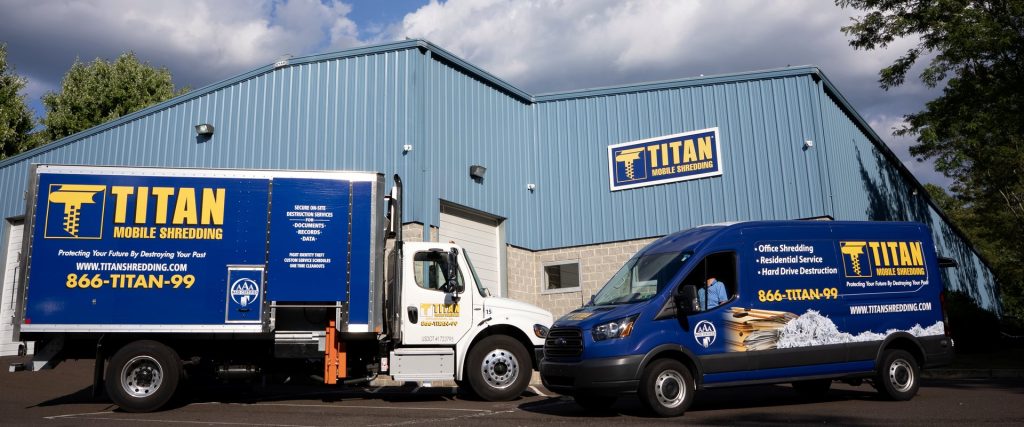
TITAN Mobile Shredding has been serving businesses across Eastern Pennsylvania, New Jersey, and Delaware since 2005. Their NAID AAA Certified shredding process exceeds the requirements of all known data protection laws, and every service is completed on-site so dealerships can witness the destruction themselves. Whether your dealership needs scheduled ongoing service, a one-time purge of accumulated records, or hard drive destruction for retiring equipment, TITAN has the experience and the equipment to handle it securely.
Your customers trusted you with their most sensitive information to buy a car. Making sure that information is handled responsibly — right through the point of destruction — is part of keeping that trust.
Call TITAN Mobile Shredding at (866) 848-2699 or visit titanshredding.com to request a free quote today.