
There’s a common assumption inside many non-profit organizations that document security is primarily a concern for banks, hospitals, and large corporations — entities with the resources, the legal departments, and the regulatory heat to make information security a priority. The organizations doing charitable work, running community programs, or providing social services tend to think of themselves as operating below the threshold where these issues really apply.
That assumption is wrong, and it creates real risk.
Non-profits handle sensitive information constantly. Donor records. Client intake files. Volunteer background checks. Grant applications and financial statements. Employee personnel files. Program data that may touch on housing situations, mental health history, immigration status, or other deeply personal circumstances. The fact that an organization’s mission is charitable does not change the nature of the information it collects — and it does not change the legal obligations that attach to handling that information responsibly.
The Information Non-Profits Actually Hold
The range and sensitivity of records inside a typical non-profit operation tends to surprise people who haven’t thought through it carefully.
On the donor side, a non-profit may hold years of giving history linked to names, addresses, email addresses, and payment information. Major donor files often include financial correspondence, meeting notes, and background research that the donor shared in confidence as part of a relationship-building process. Planned giving documentation may include estate planning details and account information that donors shared with the expectation of absolute discretion.
On the client or program side, the picture can be even more sensitive. Social service organizations collect intake information that may include Social Security numbers, income documentation, housing history, health information, and family situation details. Shelters, food pantries, legal aid organizations, addiction treatment programs, and workforce development agencies all deal with people at vulnerable points in their lives — people who share information because they need help and because they trust the organization they’re turning to.
On the operational side, non-profits are employers, and they maintain the same kinds of employee records as any other business: personnel files with Social Security numbers and direct deposit information, performance reviews, workers’ compensation documentation, health insurance records, and payroll data. They also maintain board governance records, audit files, grant compliance documentation, and vendor contracts — all of which have retention requirements and all of which can become liabilities if they’re not managed and eventually destroyed properly.
The Compliance Picture Is More Complex Than Most Non-Profits Realize
Non-profit status does not create a carve-out from the data protection laws that govern how sensitive information must be handled and destroyed.
HIPAA applies to non-profit healthcare providers and to any organization that handles protected health information, regardless of its tax status. A non-profit clinic, a community mental health center, or a hospice organization that serves patients carries the same HIPAA obligations as a for-profit hospital — including the requirement to render patient records unreadable and unrecoverable before disposal.
FACTA applies to any organization that maintains consumer financial information, which covers non-profits that process donor payment data, run credit checks on clients, or manage employee financial records. The requirement to properly dispose of that information — specifically, not just throwing it in the trash — does not distinguish between for-profit and non-profit entities.
State laws in Pennsylvania, New Jersey, and Delaware all include data protection provisions that apply to organizations maintaining personal information about residents. The obligation to implement reasonable security procedures and to properly destroy records at the end of their lifecycle is a general business requirement, not one that exempts organizations based on their charitable purpose.
For non-profits that receive federal or state grant funding, there may be additional compliance requirements built into grant agreements themselves — including specific provisions about how program data must be handled, retained, and destroyed.
Why the Risk Is Often Higher at Non-Profits
Non-profits frequently face document security challenges that are, in some ways, more acute than those at comparably sized for-profit businesses.
Resources are constrained. The administrative infrastructure that a corporation might deploy — dedicated compliance staff, regular security audits, robust records management systems — is often not available to a non-profit operating on a lean budget. Document disposal may be handled informally, if it’s handled deliberately at all. Shredding bins may not exist. Staff may not have been trained on what should and shouldn’t go in the recycling. Records may accumulate for years in a storage room that nobody has the time or authority to properly address.
High staff and volunteer turnover compounds the problem. Non-profits often rely heavily on volunteers and part-time staff, and every personnel transition is an opportunity for documents to be mishandled, for access to be poorly managed, or for sensitive materials to end up somewhere they shouldn’t be. Without a consistent, system-level approach to document destruction, the security of the organization’s records depends on whoever happens to be handling them at a given moment.
And the populations non-profits serve are often among the most vulnerable to the consequences of a privacy breach. A data breach involving the personal information of domestic violence survivors, undocumented immigrants, or individuals in addiction recovery isn’t just a compliance problem — it can have serious real-world consequences for the people whose information was exposed.
What Responsible Document Destruction Actually Looks Like
The starting point for any non-profit serious about document security is recognizing that “we shred things when we get around to it” is not a program. It’s a gap.
A real document security program begins with understanding what information the organization holds, how long different categories of records need to be retained, and what happens when they reach the end of their required retention period. Donor records, client files, employee documents, and financial records all have different retention requirements — and a blanket policy of keeping everything indefinitely is itself a liability, because it means the organization is storing and protecting records long past any legitimate purpose for keeping them.
Once a retention framework is in place, the physical process of destruction needs to be consistent and documented. Secure collection containers placed in offices, program spaces, and storage areas give staff and volunteers a defined place for documents headed for destruction — eliminating the informal recycling bin disposal that creates so much risk. Scheduled shredding service means documents are collected and destroyed on a predictable cycle rather than accumulating until someone organizes a purge.
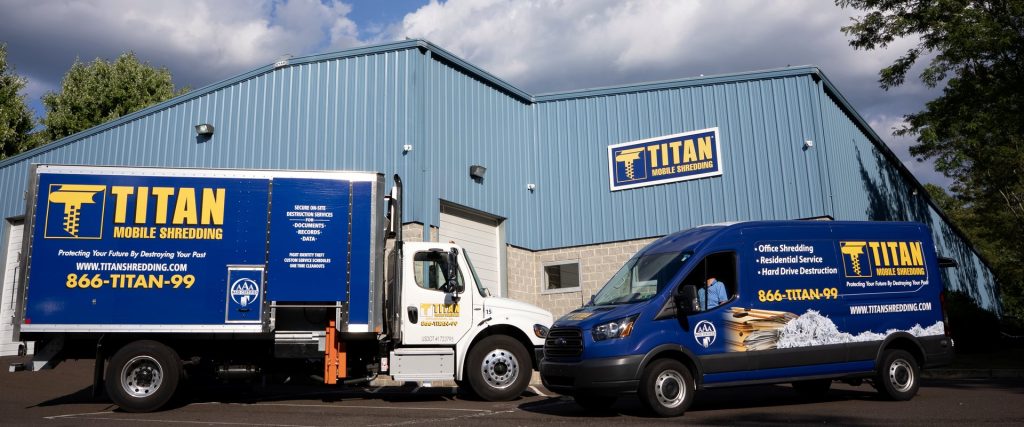
For non-profits handling particularly sensitive client information — a legal aid organization, a social service agency, a healthcare clinic — on-site mobile shredding is worth considering. Documents are destroyed at the organization’s location, in a truck parked outside, before they ever leave the premises. That chain of custody matters when the files involved contain the kind of information that demands the highest level of discretion.
Every service should come with a Certificate of Destruction — a documented record that specific materials were destroyed on a specific date, in compliance with applicable legal standards. For organizations subject to grant audits, regulatory oversight, or board governance review, that documentation is part of demonstrating that the organization is operating with the care its mission requires.
Hard Drives and the Digital Side of the Problem
Non-profits cycle through technology just like any other organization — often at a faster rate, because donated equipment tends to be older and gets replaced more frequently. Computers received as donations, laptops used by case managers, workstations in program offices, tablets used for intake — all of these devices accumulate data over their useful life, and none of that data disappears when the device is retired.
Hard drives from computers donated to or decommissioned by a non-profit can contain years of client records, donor databases, financial files, and internal communications. Wiping a drive or restoring factory settings is not the same as destroying the data it contains. Data recovery tools can retrieve information from drives that have been through standard digital erasure processes. Physical destruction — shredding the drive itself — is the only reliable endpoint.
For a non-profit handing computers to a recycler, donating equipment to another organization, or simply clearing out a storage room full of old technology, hard drive destruction is a step that should not be skipped.
The Right Partner Makes the Difference
Non-profits operate with limited administrative capacity, which makes the efficiency and reliability of a shredding partner more important, not less. An organization that can’t afford to manage document destruction internally needs a provider that handles the process completely — showing up on schedule, collecting materials securely, destroying them on-site, and providing the documentation to prove it — without requiring significant staff time or coordination to make it happen.
TITAN Mobile Shredding has been serving businesses and organizations across Eastern Pennsylvania, New Jersey, and Delaware since 2005. NAID AAA Certified since 2007, their on-site mobile shredding process meets or exceeds the requirements of all applicable data protection laws — and every service is completed at your location, so your organization witnesses the destruction firsthand. Scheduled shredding, one-time purge service, hard drive destruction, and media destruction are all available, with service options sized for organizations of every volume and budget.
The people your non-profit serves trusted you with their information at some of the most difficult moments of their lives. The donors who support your mission trusted you with their financial details and their generosity. Your employees trusted you with their personal data as a condition of their employment. Handling all of that responsibly — including at the point of destruction — is part of what it means to operate with integrity.
Call TITAN Mobile Shredding at (866) 848-2699 or visit titanshredding.com to request a free quote today.